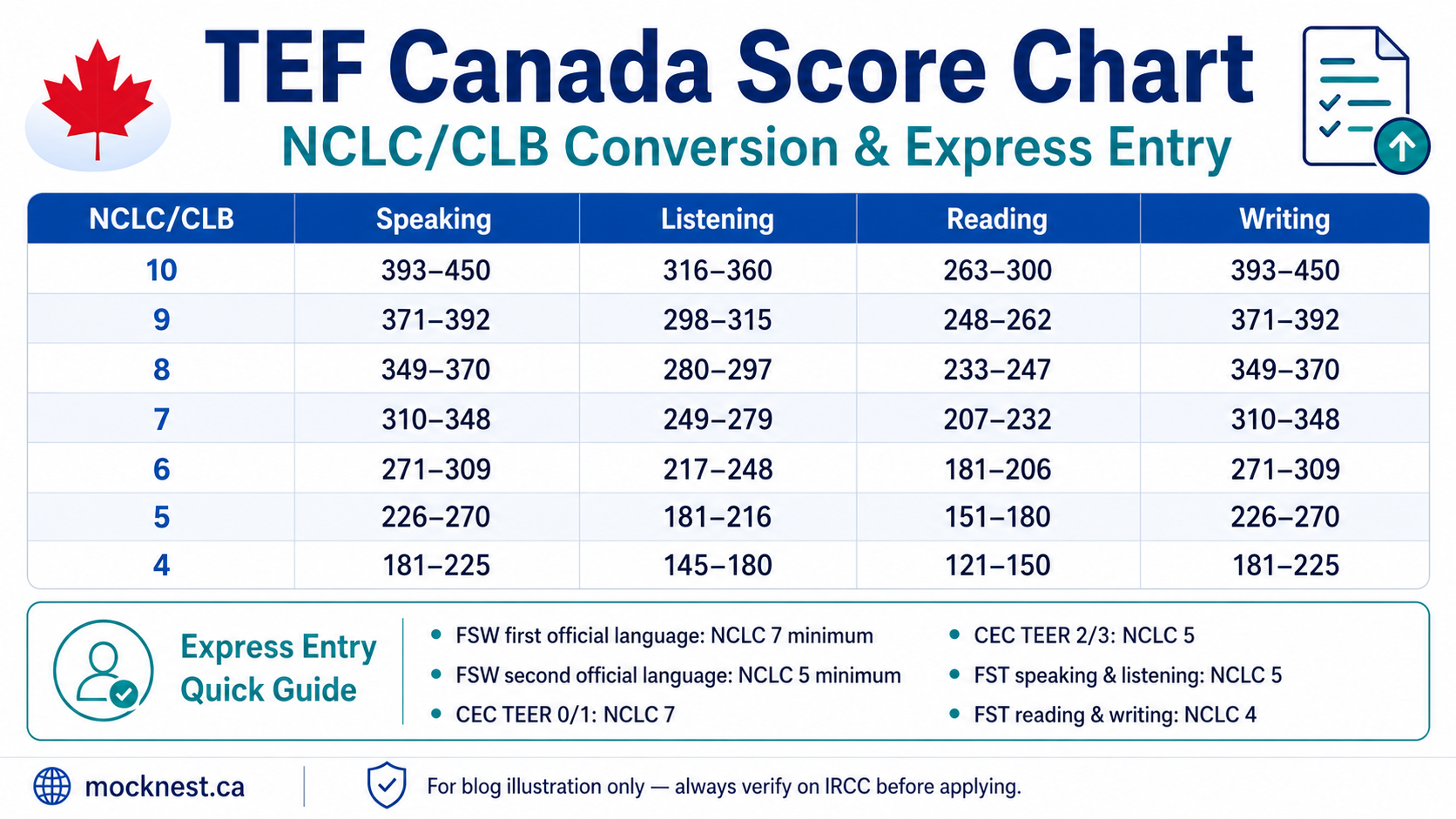
Your TEF Canada result doesn’t come as a simple pass or fail. Instead, you receive four individual scores—one each for Reading, Listening, Writing, and Speaking. IRCC then uses its official language equivalency chart to determine the NCLC level for each skill. Understanding the TEF Canada score chart is essential here, because NCLC is the French-language benchmark used by Canada’s immigration system, and you’ll often see it referred to alongside its English equivalent, the Canadian Language Benchmarks (CLB).
Here’s the one rule to remember up front: each skill is scored on its own scale, and there is no combined total. To reach a particular NCLC (or CLB) level, you must achieve the required score in every skill individually. A stronger score in one section cannot compensate for a weaker score in another.
In this guide, we’ll explain the official TEF Canada score chart, show you the scores required for Express Entry, explain how TEF Canada scores are converted to NCLC/CLB levels, and clarify the commonly misunderstood “/699” score that appears on your results certificate.
TEF Canada score chart: TEF Canada to NCLC (CLB) conversion
The table below shows the official language equivalency chart used by IRCC for Express Entry and other federal immigration programs. TEF Canada results are converted to NCLC (Niveaux de compétence linguistique canadiens) levels, the French-language benchmark used by Canada’s immigration system. The Canadian Language Benchmarks (CLB) are used for English-language tests. Although TEF Canada results are reported as NCLC levels, an NCLC 7 represents the same language proficiency benchmark as CLB 7—the difference is simply that NCLC applies to French, while CLB applies to English.
| CLB / NCLC | Reading (/300) | Listening (/360) | Writing (/450) | Speaking (/450) |
|---|---|---|---|---|
| 10 | 263–300 | 316–360 | 393–450 | 393–450 |
| 9 | 248–262 | 298–315 | 371–392 | 371–392 |
| 8 | 233–247 | 280–297 | 349–370 | 349–370 |
| 7 | 207–232 | 249–279 | 310–348 | 310–348 |
| 6 | 181–206 | 217–248 | 271–309 | 271–309 |
| 5 | 151–180 | 181–216 | 226–270 | 226–270 |
| 4 | 121–150 | 145–180 | 181–225 | 181–225 |
The four skills correspond to the French section names you’ll see on your TEF Canada results:
- Compréhension écrite – Reading
- Compréhension orale – Listening
- Expression écrite – Writing
- Expression orale – Speaking
Always check the latest IRCC language equivalency chart before submitting your Express Entry profile, as IRCC’s published equivalency table is the official reference used to assess language proficiency for immigration.
Important: the “Score / 699” on your certificate is not the score you enter
This is one of the most common TEF Canada mistakes, so check your results carefully. Your TEF Canada certificate may show a column labelled “Score / 699”, but this is not the score you should enter in your Express Entry profile.
IRCC instructs applicants to use the “Équivalence ancien score” column instead. These are the per-skill equivalency scores used for immigration: Reading out of 300, Listening out of 360, and Writing and Speaking out of 450.
So, when completing your Express Entry profile, do not copy the “Score / 699” numbers. Use only the equivalency scores for each skill. Entering the wrong score column can lead to incorrect language results in your profile and may put your application at risk.
What TEF Canada score do you need for NCLC 7 (CLB 7)?
For many Express Entry applicants, NCLC 7 is the most important milestone to reach. It is the minimum French language level required to qualify for additional French-language CRS points and to be eligible for French-language proficiency category-based draws, provided you meet IRCC’s other eligibility requirements.
To achieve NCLC 7 (equivalent to CLB 7) in TEF Canada, you need at least:
- Reading: 207 out of 300
- Listening: 249 out of 360
- Writing: 310 out of 450
- Speaking: 310 out of 450
You must achieve these minimum scores in all four skills. A higher score in one section cannot make up for a lower score in another.
NCLC 7 is generally considered an upper-intermediate (B2) level of French. For Express Entry candidates, reaching this benchmark can significantly strengthen a profile by making them eligible for up to 50 additional CRS points (depending on their English-language results) and for French-language proficiency category-based selection.
How TEF Canada scoring works
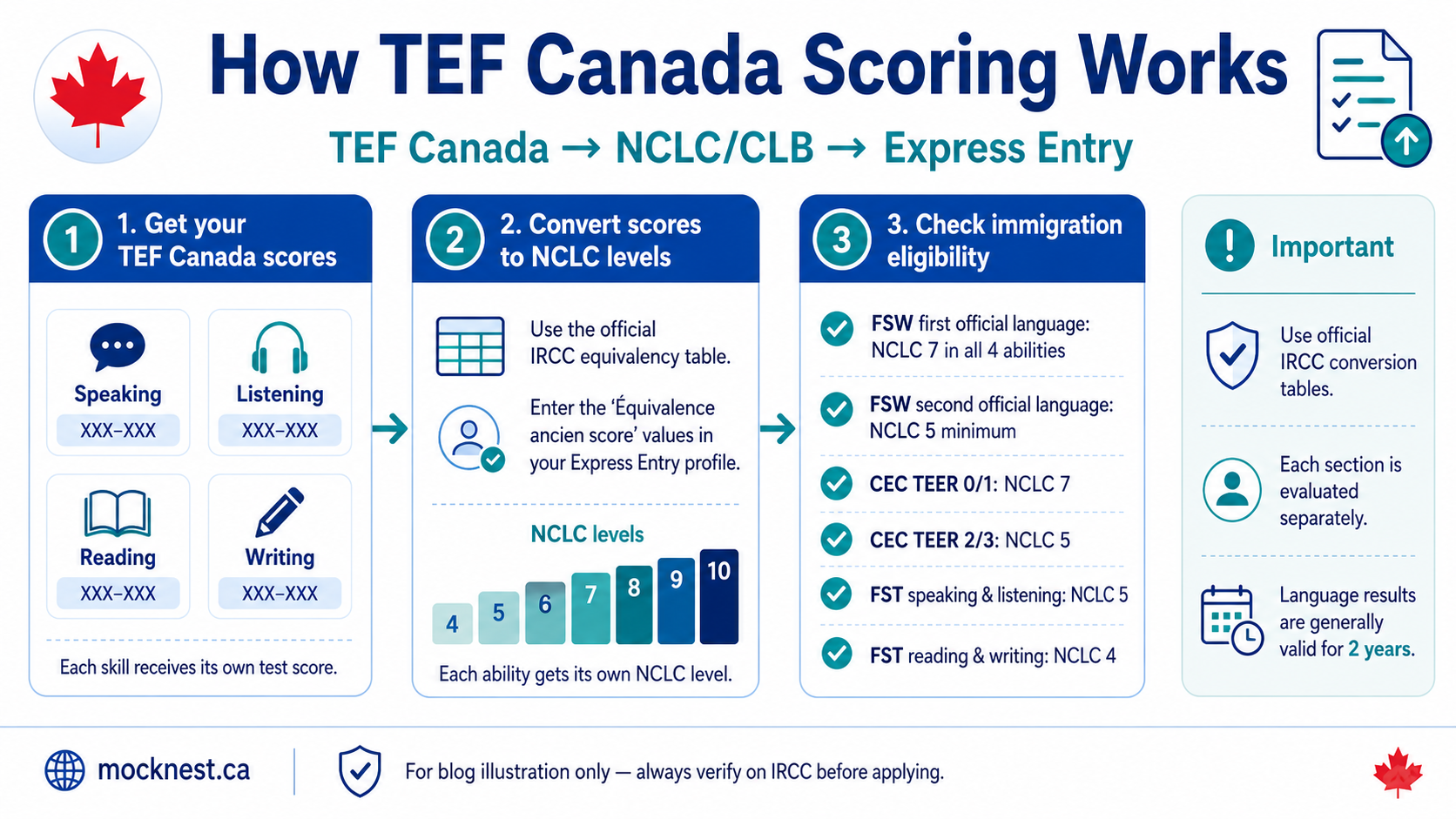
Unlike IELTS, which uses a single 9-band scoring system across all four skills, TEF Canada assigns a separate score to each language skill using its own scale. Reading, Listening, Writing, and Speaking are all scored independently, and each score is then matched to an NCLC (CLB) level using IRCC’s official language equivalency chart.
Because each skill has a different maximum score, it’s important to judge your performance against the required score for that specific section rather than looking for an overall percentage or total score.
Reading (Compréhension écrite) – Score out of 300
Your Reading score is based on your performance in the reading comprehension section and is reported on a scale of 300 points. Success depends on more than just vocabulary—you need to understand the writer’s purpose, identify key details, make logical inferences, and manage your time effectively.
Practising with realistic exam-style passages under timed conditions is one of the best ways to improve both speed and accuracy.
Listening (Compréhension orale) – Score out of 360
Listening is scored out of 360 points and evaluates your ability to understand spoken French in a wide variety of real-life situations, including announcements, conversations, interviews, and discussions.
Since the recordings reflect authentic spoken French and are played under exam conditions, regular practice with realistic audio is essential for improving comprehension and confidence.
Writing (Expression écrite) – Score out of 450
Writing is scored out of 450 points and assesses your ability to communicate clearly, organize ideas logically, and use the appropriate tone and register for each task.
Strong performances come from producing well-structured responses that fully address the task while demonstrating accurate grammar and a suitable range of vocabulary.
Speaking (Expression orale) – Score out of 450
Speaking is also scored out of 450 points and measures your ability to communicate naturally and effectively in spoken French. Examiners evaluate not only grammatical accuracy but also fluency, pronunciation, coherence, vocabulary, and your ability to respond appropriately during the interaction.
Regular speaking practice with realistic exam scenarios and constructive feedback is one of the most effective ways to improve your score.
How to achieve your target TEF Canada score
Understanding the TEF Canada score chart is only the first step. The next step is identifying the gap between your current level and the NCLC score you need—and building a study plan to close it.
Rather than studying general French, successful candidates usually focus on the skills that are holding their overall result back. Since each section is scored independently, improving your weakest skill can have the biggest impact on your final NCLC level.
A simple preparation strategy is to:
- Take a full-length diagnostic TEF Canada mock test under timed conditions.
- Compare your score in each skill with the official NCLC score chart.
- Identify the section furthest from your target.
- Spend most of your study time improving that skill while continuing to practise all four sections regularly.
- Repeat full mock tests to monitor your progress and adjust your preparation as your scores improve.
Consistent practice under realistic exam conditions helps you become familiar with the question types, improve your time management, and build the confidence needed on test day.
If you’d like to assess your current level, you can try our free TEF Canada mock test at www.mocknest.ca. You can also book a free demo session with one of our tutors to receive personalised feedback and a study plan based on your strengths and weaknesses. When you’re ready for more structured preparation, explore our TEF Canada mock test plans, one-to-one classes, and free practice resources designed to help you achieve your target score.
Frequently asked questions
Is there an overall TEF Canada score?
No. TEF Canada does not have a single overall score or pass mark. Each of the four language skills—Reading, Listening, Writing, and Speaking—is scored separately and converted to an NCLC level (the French equivalent of CLB). Your overall language profile depends on your score in each individual skill.
Which TEF Canada score do I enter into my Express Entry profile?
Use the equivalency scores shown on your TEF Canada certificate—Reading (/300), Listening (/360), Writing (/450), and Speaking (/450). Do not enter the "Score / 699" values, as IRCC does not use them to assess language proficiency for Express Entry.
What TEF Canada score is equivalent to NCLC 7 (CLB 7)?
To achieve NCLC 7 (equivalent to CLB 7), you need at least:
Reading: 207/300
Listening: 249/360
Writing: 310/450
Speaking: 310/450
You must meet these minimum scores in all four skills. NCLC 7 is generally considered equivalent to an upper-intermediate (B2) level of French.
Is NCLC the same as CLB?
Not exactly. NCLC (Niveaux de compétence linguistique canadiens) is the benchmark system used to assess French-language proficiency, while CLB (Canadian Language Benchmarks) is used for English-language proficiency. The benchmark levels correspond to one another for immigration purposes, so NCLC 7 represents the same proficiency level as CLB 7, even though they apply to different languages.
How long are TEF Canada results valid?
TEF Canada results are valid for two years from the date of the test. To be accepted by IRCC, your results must still be valid both when you submit your Express Entry profile and when you apply for permanent residence after receiving an Invitation to Apply (ITA).
Why should I aim for NCLC 9 if NCLC 7 already qualifies?
NCLC 7 is the key milestone because it can make you eligible for additional French-language CRS points and French-language proficiency category-based draws, provided you meet IRCC's other requirements. Achieving NCLC 9 can further strengthen your CRS score through the language factor, making your profile more competitive overall.
The bottom line
The TEF Canada score chart is your roadmap to understanding exactly what you need to achieve in each language skill. Since every section is scored independently, it’s important to know your target score for Reading, Listening, Writing, and Speaking—and to prepare accordingly.
For most Express Entry candidates, NCLC 7 is the major milestone. Just remember one crucial rule: when completing your Express Entry profile, always use the equivalency scores shown on your TEF Canada certificate—not the “Score / 699” values.
Once you know your target, the rest comes down to focused preparation. Take a realistic TEF Canada mock test, identify your weakest skill, practise under exam conditions, and track your progress until you consistently achieve the scores you need. With the right strategy and regular practice, reaching your target NCLC level is entirely achievable.