The speaking test TEF Canada puts in front of you is the part of the exam that makes most candidates nervous, and I understand why. In the Expression Orale module, there is no screen between you and the test. You sit face to face with an examiner, the recorder is on, and you have no preparation time. Many students tell us at Mocknest that they can read and listen at a strong level, but the moment they have to speak, their mind goes blank.
Here is the good news. The TEF Canada speaking topics follow very predictable patterns. Once you understand the two sections, practice the common scenarios, and learn a simple answer structure, the speaking test becomes one of the most trainable parts of the whole exam. In this guide, I will walk you through how the speaking section works, the topics that appear again and again, sample questions and answers you can adapt, and the mistakes that quietly cost candidates their CLB 7.
Speaking Test TEF Canada: How It Works
The TEF Canada speaking module lasts 15 minutes in total and has two sections:
Section A (5 minutes) — Obtaining information. You receive a short announcement or advertisement, for example a notice about a French course, a job posting, or an apartment for rent. Your task is to play a role, usually an interested client, and ask the examiner around 10 varied questions about the announcement. You are being tested on whether you can gather practical information politely and naturally.
Section B (10 minutes) — Convincing someone. You receive a situation, for example convincing a friend to join an activity or an event. The examiner plays the friend and raises objections. Your task is to present the idea, give logical arguments, respond to their counterarguments, and close the conversation naturally.
Speaking is scored out of 450 points, and for most Express Entry candidates the target is at least 310 out of 450, which corresponds to NCLC 7 on the official IRCC language equivalency chart. Examiners are listening for fluency, vocabulary range, grammatical accuracy, and, above all, whether you sound like someone handling a real-life situation rather than reciting a memorised speech.
Section A topics: the announcements you should expect
Section A scenarios almost always come from everyday practical life. In our mock speaking sessions, these themes appear constantly:
- A language course or evening class being advertised
- A job or volunteer opportunity
- An apartment or room for rent
- A gym, sports club, or swimming lessons
- A cultural activity: concert, exhibition, festival, guided tour
- A service: moving company, babysitting, computer repair
- A trip, excursion, or travel package
Whatever the announcement, your ten questions should cover the same practical categories. Train yourself to run through this mental checklist: place, dates and schedule, price and payment, duration, what is included, who it is for, how to register, conditions or requirements, accessibility, and contact details.
Sample Section A questions you can adapt
Imagine the announcement is for French conversation classes. Here are ten varied questions, moving from simple to more developed:
- Où est-ce que les cours ont lieu exactement ?
- Quels sont les horaires des séances ?
- Combien coûte l’inscription ?
- Est-ce qu’il y a une réduction pour les étudiants ?
- Combien de personnes y a-t-il par groupe ?
- Les cours s’adressent à quel niveau ?
- Est-ce que le matériel pédagogique est inclus dans le prix ?
- Comment est-ce que je peux m’inscrire ?
- Est-ce qu’il est possible d’assister à une séance d’essai gratuite ?
- Pourriez-vous me donner un numéro de téléphone pour vous joindre ?
Notice the variety: some questions use “est-ce que,” some use inversion-free intonation, one uses the conditional “pourriez-vous.” That variety of structures is exactly what the examiner is scoring. If all ten questions follow the same pattern, your grammar range looks limited even if every sentence is correct.
Section B topics: the persuasion scenarios
Section B is where your score is really decided, because it lasts twice as long and tests spontaneous argumentation. The scenarios almost always ask you to convince a friend, colleague, or family member to do something. Common topics include:
- Convincing a friend to attend a festival, concert, or exhibition with you
- Persuading a colleague to join a sports activity or gym
- Convincing someone to take a trip or weekend excursion
- Persuading a friend to adopt a healthier habit or hobby
- Convincing a family member to try a new restaurant, course, or volunteer activity
A sample answer framework that works
You cannot memorise a full answer, because the examiner will interrupt with objections — that is the design of the test. What you can memorise is a structure. We teach this four-step frame in our speaking sessions:
1. Present the idea with enthusiasm. “Écoute, j’ai découvert quelque chose qui va vraiment te plaire. Il y a un festival de musique ce week-end au parc, et je pense qu’on devrait y aller ensemble.”
2. Give two or three concrete arguments. “D’abord, l’entrée est gratuite, donc ça ne coûte rien d’essayer. Ensuite, il y aura des groupes de plusieurs pays, c’est une occasion rare d’écouter de la musique qu’on ne connaît pas. Et en plus, la météo annonce du soleil.”
3. Handle the objection without panic. If the examiner says they are too tired or too busy, acknowledge first, then counter: “Je comprends que tu sois fatigué après la semaine, mais justement, c’est en plein air, c’est relaxant, on n’est pas obligés de rester longtemps. On peut y aller juste deux heures.”
4. Close naturally with a concrete proposal. “Alors, on fait comme ça ? Je passe te chercher samedi à quatorze heures, et si ça ne te plaît pas, on part quand tu veux. Ça marche ?”
That closing question matters more than students realise. Ending the role play yourself, with a specific time and a friendly confirmation, shows the examiner you can drive a conversation to its natural conclusion — one of the exact criteria on the grading grid.
The mistakes that cost candidates CLB 7
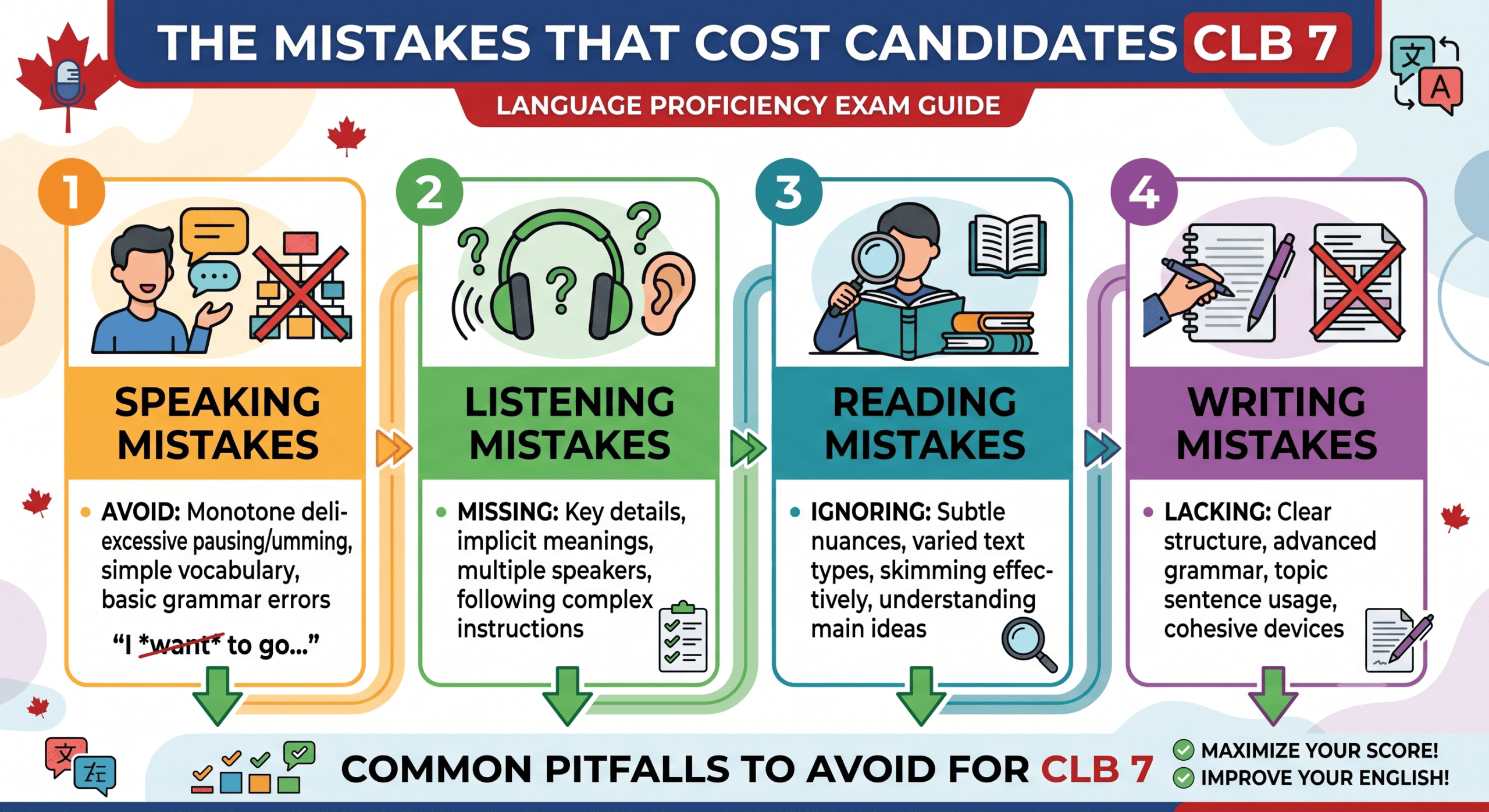
After hundreds of mock speaking sessions, the same patterns come up. These are the ones to eliminate first:
Reciting instead of reacting. Examiners recognise memorised monologues immediately, and the objection phase is designed to break them. Practice responding to unexpected pushback, not delivering speeches.
Repeating the same question structure ten times in Section A. Ten grammatically perfect “est-ce que” questions score lower than eight questions with varied structures.
Overly simple vocabulary. Saying “c’est bien” and “c’est intéressant” for everything caps your score. Build a small bank of richer alternatives: “c’est une occasion à ne pas manquer,” “ça vaut vraiment le coup,” “c’est enrichissant.”
Panicking at silence. A pause to think is fine. Filling every silence with “euh” for ten minutes is not. Learn natural fillers instead: “alors,” “en fait,” “tu vois,” “disons que.”
Ignoring the register. Section A is usually formal (vous), Section B is usually informal (tu). Mixing them up signals that you are not reading the social situation, which is precisely what the module tests.
How to practice speaking when you have no partner
This is the most common question we get. Reading and listening can be self-studied with mock tests, but speaking improves fastest with a live human who pushes back. If you are preparing alone, record yourself answering a Section B scenario for ten minutes, then listen for repeated structures and fillers. Shadowing French podcasts also trains rhythm and pronunciation.
But honest advice: at some point you need real interaction with someone who objects, interrupts, and grades you against the actual TEF criteria. That is exactly what our one-to-one speaking simulations with native tutors are built for — each session mirrors the real 15-minute exam, with Section A and Section B, followed by scored feedback on the same criteria the examiner uses. You can book a free demo session to experience the format, and when you are ready for full preparation, our mock test plans include live speaking sessions alongside the other three modules. If you are still building your overall study routine, start with our guide on how to prepare for TEF Canada online.
Frequently asked questions
How many topics are there in the TEF Canada speaking test?
There are two tasks: Section A (5 minutes, obtaining information from an announcement) and Section B (10 minutes, convincing someone to do something). Each task has one scenario, drawn from everyday practical situations.
Do I get preparation time before the speaking test?
No. You receive the document and begin immediately. This is why practising the question checklist for Section A and the four-step persuasion frame for Section B is so effective — the structure is prepared even though the content is spontaneous.
Can I memorise answers for TEF Canada speaking?
You can memorise structures, connectors, and vocabulary, but not full answers. The examiner interacts with you and raises objections, so a recited script falls apart quickly and scores poorly on spontaneity.
What score do I need in speaking for CLB 7?
You need at least 310 out of 450 in Expression Orale for NCLC 7 (the French equivalent of CLB 7). Check our TEF Canada score chart guide for the full conversion table across all four skills.
Is the speaking test TEF Canada uses done with a real person?
Yes. Expression Orale is a face-to-face role play with an examiner, and the session is recorded so it can be double-evaluated.
The bottom line
The speaking test TEF Canada candidates fear is not a mystery. Section A is always practical information-gathering, Section B is always persuasion, and both reward candidates who trained with a structure instead of a script. Build your question checklist, master the four-step persuasion frame, vary your grammar, and practice with a real person who pushes back. Do that consistently, and the module most candidates fear becomes the one where you gain your points.