
If you’re preparing for Canadian immigration, you’ll eventually face one important question: TEF Canada vs. TCF Canada — which exam should you choose? Both are accepted by IRCC, assess the same four language skills, and convert to the same NCLC/CLB levels. So does the choice actually matter?
Yes — more than most people think. The two exams differ in format, question style, and timing, and most candidates score noticeably better in one of them. Choosing the right one for your profile can be worth a full NCLC level. Here is the honest comparison we give our own students at MockNest.
TEF vs TCF Canada at a glance
| Feature | TEF Canada | TCF Canada |
|---|---|---|
| Full name | Test d’évaluation de français | Test de connaissance du français |
| Run by | Paris Chamber of Commerce and Industry | France Éducation International (also runs DELF/DALF) |
| Listening | 40 questions in 40 minutes, audio plays once, deliberate trap answers | 39 questions in ~35 minutes, ramps from easy to hard |
| Reading | 40 questions in 60 minutes, fewer but longer passages | 39 questions in 60 minutes, ramps from easy to hard |
| Writing | 2 tasks in 60 minutes — news story continuation + formal letter | 3 shorter tasks in 60 minutes, increasing difficulty |
| Speaking | 2 live roleplay tasks, ~15 minutes | 3 tasks, ~12 minutes — interview + exchange + opinion |
| Scoring | Each skill scored on its own scale, with per-module thresholds | 100–699 scale for MCQ sections, 0–20 for speaking/writing |
| Accepted by IRCC | Yes (Express Entry, PNP, citizenship) | Yes (Express Entry, PNP, citizenship) |
| Result validity | 2 years | 2 years |
| Typical cost | Roughly CA$400–460, varies by centre | Roughly CA$400–460, varies by centre |
First, what’s identical
Before the differences, know what does not change with your choice: both exams are accepted equally by IRCC for Express Entry, the French-speaker bonus points, French-language category draws, and citizenship applications. Both test all four modules, both convert to NCLC levels, and results from both are valid for two years. Immigration officers do not care which one you took — so this is purely a question of which exam lets you perform best.
Module-by-module: where the exams actually differ
Listening (Compréhension Orale)
TEF Canada: 40 questions in 40 minutes. The audio plays once for most questions, and the questions are known for deliberate trap answers — options that repeat a word you heard but twist the meaning. Candidates who have practiced the question style learn to spot the traps. Our Compréhension Orale guide explains the question types in detail.
TCF Canada: 39 questions in about 35 minutes, arranged from very easy to very hard. The early questions settle nerves, but the final stretch reaches C1–C2 difficulty that most candidates cannot answer.
Which feels easier: TCF’s ramp structure is psychologically gentler and you aren’t punished for the hardest questions if your target is NCLC 7. TEF listening punishes the unprepared more, but rewards preparation more — trap-spotting is a learnable skill.
Reading (Compréhension Écrite)
TEF Canada: 40 questions in 60 minutes. Fewer but longer passages reward strong reading efficiency and time management. See our Compréhension Écrite guide for skimming and scanning techniques.
TCF Canada: 39 questions in 60 minutes, again ramping from easy to hard, with harder top-end texts.
Which feels easier: most candidates find TCF reading more comfortable at the NCLC 7 level. TEF reading is a grind, and running out of time is the most common complaint.
Writing (Expression Écrite)
TEF Canada: two tasks in 60 minutes — continuing a news story and writing a formal opinion letter. The formats are rigid and predictable, which is exactly why prepared candidates love them: you can build a template for each task. We break down both tasks in our Expression Écrite guide.
TCF Canada: three shorter tasks, from a simple message to a structured argumentative text. Less predictable, less template-friendly, more varied.
Which feels easier: if you prepare templates, TEF writing is the more score-able section — predictability is a gift. If you dislike memorising structures, TCF’s shorter varied tasks may suit you better.
Speaking (Expression Orale)
TEF Canada: two live roleplay tasks with an examiner in about 15 minutes. The scenarios repeat heavily across sittings; our speaking test TEF Canada guide lists the most common ones.
TCF Canada: three tasks in about 12 minutes — a short interview, a prepared exchange, and a spontaneous opinion.
Which feels easier: candidates who rehearse the TEF roleplays consistently outperform their “real” French level, because the format is predictable. Candidates who freeze in roleplay situations sometimes prefer TCF’s interview style. Either way, this is the module where practicing with a real person matters most — you cannot self-assess speaking.
Scoring and how it maps to CLB
Both tests score each skill on its own scale, and IRCC converts those scores into CLB (also called NCLC) levels — one level per skill. For most Express Entry candidates, the target is CLB 7 / NCLC 7 in all four skills, roughly an upper-intermediate (B2) level. That’s the benchmark that unlocks the French-language CRS bonus and qualifies you for French category draws.
The practical takeaway is the same for both exams: find the exact score you need for your target NCLC level in each module before you start preparing, and measure every practice test against those numbers.
Cost, length and availability
Prices vary by test centre and country, but the two exams cost roughly the same — typically in the CA$400–460 range. TEF Canada usually runs a little longer than TCF Canada, though both land in the three-hour range. Availability is often the real deciding factor: not every test centre offers both exams, and session dates fill up. Check current test centres and dates on the official TEF Canada and TCF Canada pages.
So which should you choose?
Choose TEF Canada if: you are willing to prepare in a structured way and want your preparation to convert directly into marks. Predictable writing templates, repeating speaking scenarios, and learnable listening traps mean format practice pays off more here than in almost any other French exam. This is the exam where a structured study plan delivers the biggest return.
Choose TCF Canada if: you have limited preparation time, you find ramping difficulty less stressful than uniform difficulty, or roleplay-style speaking genuinely paralyzes you and an interview format does not.
If you are still unsure: take a full-length mock test of each format and compare your converted NCLC results. The exam where your practice scores are higher is your exam — and it’s precisely why we offer mock tests for both exams.
One important rule: you can only use results from one test in your application — you can’t mix your TEF speaking score with your TCF writing score, so pick a single test and prepare for that format end to end.
How to prepare for TEF or TCF Canada
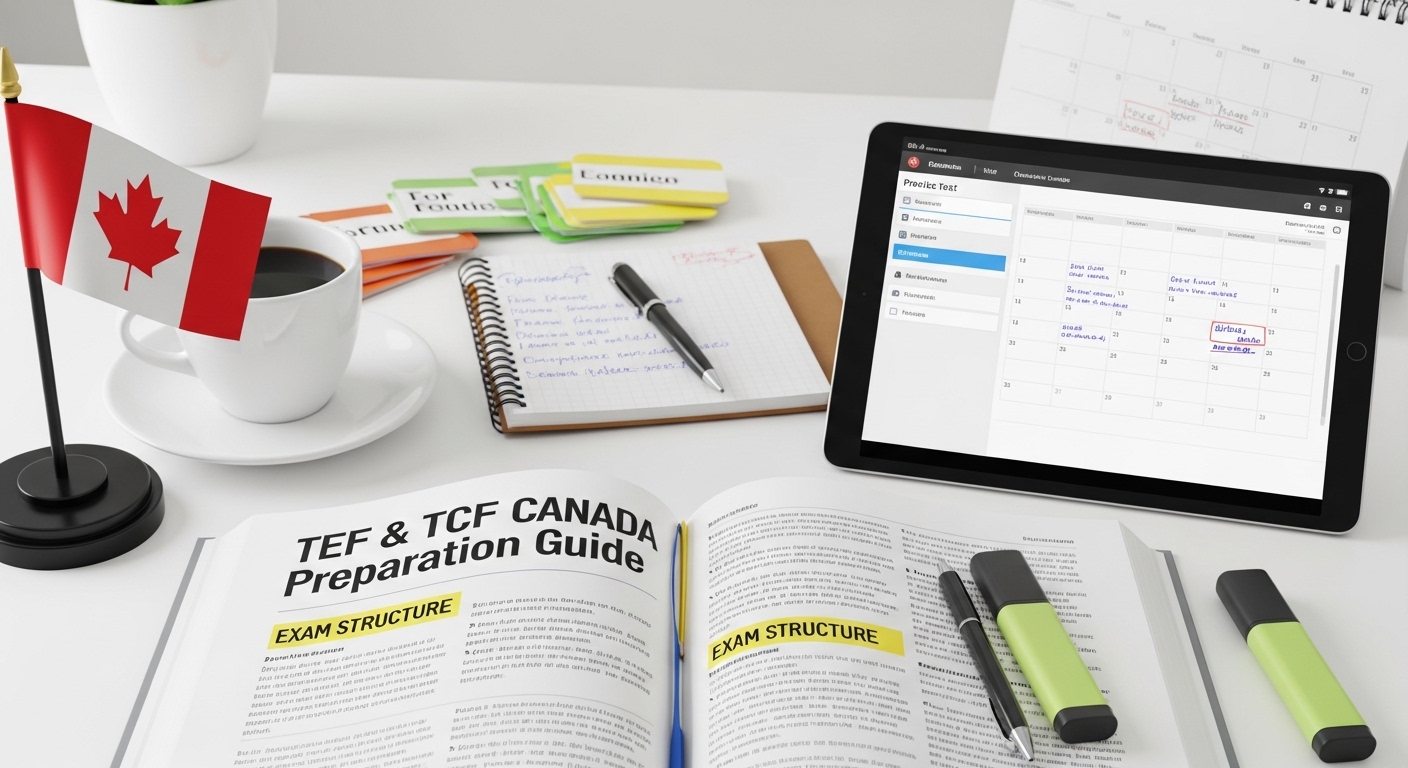
Whichever test you choose, the winning formula is the same — practice under real exam conditions, not just general French study. At MockNest, we specialise in TEF Canada and TCF Canada preparation with exam-style mock tests, timers, real audio, and feedback. Here’s how to build your prep around the four skills:
- Train your ear with our listening (compréhension orale) practice.
- Sharpen speed and accuracy in reading (compréhension écrite).
- Practice live, exam-style speaking (expression orale) with native and certified tutors.
- Master the tasks in writing (expression écrite) with expert evaluation.
Not sure where you stand yet? Try a free TEF Canada mock test to experience the real format, or book a free demo session so a tutor can check your level and map out a plan. When you’re ready to go all in, compare our TEF Canada mock test plans.
Frequently asked questions
Is TEF or TCF easier for Canadian immigration? Neither is objectively easier. Both test the same level of French and are equally accepted by IRCC. The “easier” test is the one whose format fits your strengths, which is why trying a mock test of each is the best way to decide.
Do TEF Canada and TCF Canada give the same points for Express Entry? Yes. Both convert to NCLC levels, and IRCC treats the resulting levels identically for Express Entry points, the French-speaker bonus, category-based draws, and citizenship.
Are TEF and TCF the same as TEF Canada and TCF Canada? No, and this is the most expensive mistake candidates make. IRCC only accepts the Canada-specific versions — TEF Canada and TCF Canada. A regular TEF or TCF result, however good, cannot be used for Canadian immigration. Verify the exact exam name before you pay for registration.
Can I take TCF if I already took TEF? Yes, you can take a different test, but there’s usually a waiting period between attempts, and rules can change — confirm the current policy with your test centre.
Can I switch from TEF Canada to TCF Canada after a bad result? Yes. There is no rule binding you to one exam — you can take either exam, in any order, as many times as you wish, and submit whichever valid result is best. Each attempt requires taking all four modules again and paying the full fee.
What French score do I need for Express Entry? Most candidates aim for CLB 7 (NCLC 7) in all four skills — roughly an upper-intermediate B2 level. That benchmark unlocks the French CRS bonus and makes you eligible for French-language category draws.
The bottom line
In the TEF vs TCF Canada choice, there’s no wrong answer — only the test that fits you best. Both open the same door to Canadian PR, both score the same skills, and both reward smart, format-specific preparation far more than raw fluency. Pick the format that feels natural, then practice it until exam day holds no surprises.
Ready to start? Take your free TEF Canada mock test today and turn your French into Express Entry points.