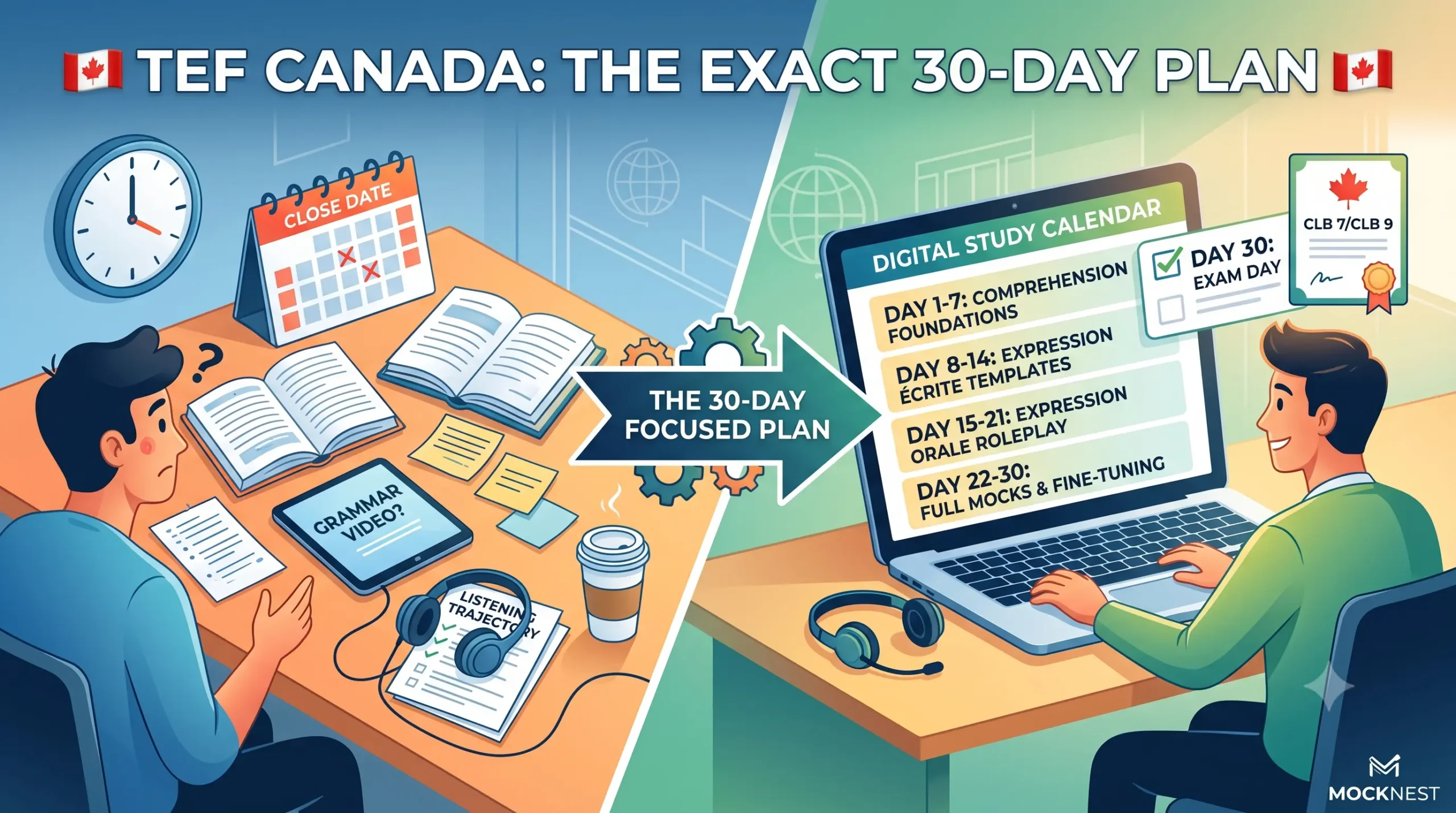
If your exam date is only a few weeks away, you need more than motivation. You need a TEF Canada study plan that tells you exactly what to do every single day. Most candidates fail not because their French is weak, but because their preparation is scattered — a little listening today, a random grammar video tomorrow, and no real practice under exam conditions until it is too late.
This 30-day plan fixes that. It is the same structure we use with our students at MockNest, and it works whether you are aiming for CLB 5 or pushing for CLB 7 and above for Express Entry. Each week has one clear focus, and each day has a specific task that takes about two to three hours.
Before you start, one honest note. Thirty days is enough to sharpen your French and master the exam format. It is not enough to jump from beginner to CLB 7. If you are starting from a low level, use this plan as your final month after a longer period of learning. If you are unsure where you stand, read our guide on how to prepare for TEF Canada first — it covers the long-term preparation strategy, while this post gives you the day-by-day schedule.
Before Day 1: Take a diagnostic mock test
Do not skip this step. On the day before you begin, sit one full TEF Canada mock test under real exam conditions — timed, no dictionary, no pauses. You need two things from it:
- Your baseline score in each module. Convert your results to NCLC/CLB levels so you know exactly how far you are from your target.
- Your weakest module. The plan below gives every module attention, but you will add extra time to your weakest one throughout the month.
Write both down. On Day 30, you will compare.
Week 1 (Days 1–7): Comprehension foundations
The first week builds the two receptive skills — listening and reading — because they improve fastest and they feed everything else. When you understand more French, your speaking and writing improve almost automatically.
Day 1 — Learn the exam inside out. Spend today studying the structure of every module: timing, question types, and scoring. Our TEF Canada exam guide covers the complete 2026 format and score chart. Knowing the format is free marks — no French skill required.
Day 2 — Compréhension Orale drills. Work through one full listening section, then review every wrong answer and identify why you missed it (vocabulary, speed, or distraction by a trap option). Our Compréhension Orale guide explains the question types and traps.
Day 3 — Compréhension Écrite drills. Same method with reading: one timed section, then a slow review. Read our Compréhension Écrite guide for the skimming and scanning techniques that save time.
Day 4 — Vocabulary day. Build your exam vocabulary from your Day 2–3 mistakes. Create flashcards for every word you missed. Add 30 high-frequency words on daily-life topics: work, housing, travel, services.
Day 5 — Listening immersion. No drills today. Listen to two hours of natural French — Radio-Canada, French podcasts, YouTube news. Train your ear at real speed so exam audio feels slow.
Day 6 — Mixed timed practice. One listening section and one reading section back to back, fully timed. Endurance matters: the real exam is long, and concentration fade costs marks.
Day 7 — Review and rest. Review the week’s flashcards, re-read your error log, and take the evening off. Rest is part of the plan.
Week 2 (Days 8–14): Expression Écrite
Writing is where a template gives you the biggest score jump in the shortest time. Both writing tasks follow predictable patterns, so this week you build a reusable structure for each and practice until it is automatic. Keep 30 minutes of listening in the background every day — comprehension skills fade fast without contact.
Day 8 — Learn the two tasks. Study Section A (continuing a news story) and Section B (expressing and defending an opinion). Our Expression Écrite guide breaks down what examiners reward.
Day 9 — Build your Section A template. Draft a flexible structure for the news continuation: setting the scene, adding facts, quoting a witness, closing. Write one full Section A response using it.
Day 10 — Build your Section B template. Create your opinion-letter skeleton: introduction, two or three arguments with examples, a counter-argument, conclusion. Write one full response.
Day 11 — Timed writing. Both tasks together under exam timing. No template notes allowed — it has to live in your head.
Day 12 — Correction day. Review your Day 11 writing line by line. Hunt your personal error patterns: gender agreement, verb tenses, accents. Most candidates repeat the same five mistakes; find yours and drill them.
Day 13 — Timed writing, round two. Both tasks again, new topics, fully timed. Compare against Day 11 — you should see fewer of your signature errors.
Day 14 — Review and rest. Update the error log, revise flashcards, rest.
If you can, get at least one of this week’s essays corrected by a professional. Self-correction misses the mistakes you don’t know you are making — this is exactly what our tutors do in the writing feedback sessions.
Week 3 (Days 15–21): Expression Orale
Speaking is the module candidates fear most, and the one that responds best to structured practice. The topics are highly predictable — we listed the most common ones, with sample answers in French, in our speaking test TEF Canada guide. Keep that post open all week.
Day 15 — Learn the format and the openers. Section A is an information-gathering roleplay; Section B is persuading someone. Memorize your opening lines and question structures for Section A — they work for almost any topic.
Day 16 — Section A practice. Pick five Section A prompts and record yourself on your phone. Listen back. Hearing your own French is uncomfortable and incredibly effective.
Day 17 — Section B practice. Five Section B prompts, recorded. Focus on structure: state your goal, give arguments, handle objections, close politely.
Day 18 — Fluency day. Speak French for 30 minutes without stopping — describe your day, argue with yourself about a topic, narrate what you see. Hesitation, not grammar, is what kills speaking scores.
Day 19 — Full speaking simulation. Both sections, timed, recorded in one sitting. If possible, do this one with a real person — a tutor, a partner, anyone who can respond. Speaking to a human under pressure is a different skill than speaking to your phone, and it is the one the exam tests. This is the single most valuable session to do with a native French tutor.
Day 20 — Weak-point drills. Listen to all your recordings from the week. Drill whatever repeats: a tense you avoid, filler words in English, missing liaisons.
Day 21 — Review and rest. Light revision only. Your voice needs rest too.
Week 4 (Days 22–30): Full mock tests and fine-tuning
The final week is about exam conditions, stamina, and confidence. No new material — you sharpen what you have.
Day 22 — Full mock test #1. All modules, one sitting, real timing. Treat it as the real day: same start time as your actual exam if possible.
Day 23 — Deep review. Go through every mistake from the mock. Convert your scores to CLB and compare with your Day 0 baseline. Adjust the remaining days to target whatever module lags.
Day 24 — Weakest module intensive. A full day on your lowest-scoring module, using the relevant module guide and targeted drills.
Day 25 — Full mock test #2. Again, complete and timed.
Day 26 — Review + writing polish. Review the mock, then one final pair of timed writing tasks to keep your templates sharp.
Day 27 — Speaking polish. One final recorded speaking simulation plus a review of your best recordings — end the week hearing yourself at your best.
Day 28 — Full mock test #3. Your final complete rehearsal. By now the format should feel routine — that calm is worth real points.
Day 29 — Light review only. Flashcards, error log, your two writing templates, your speaking openers. No new practice, no cramming. Prepare your documents and plan your route to the test centre.
Day 30 — Exam day. Eat properly, arrive early, and trust the plan. You have done the format nine or more times this month; the examiners are simply about to see rehearsal number ten.
How to adapt this plan
If you have 60 days: run Weeks 1–3 at half pace (two days per task) and keep Week 4 as your final two weeks with a mock test every three days.
If you work full time: shift the heavy sessions (full mocks, timed writing) to weekends and keep weekday sessions to 90 focused minutes. The order stays the same.
If one module is far behind: steal Day 5, Day 18, and Day 24 for that module. Those are the flexible days.
FAQ
Is 30 days enough to prepare for TEF Canada? Yes — if your French is already at an intermediate level or higher. Thirty days of structured practice is enough to master the exam format, fix recurring errors, and typically gain one CLB level. It is not enough to build the language itself from a beginner level.
How many hours a day should I study for TEF Canada? This plan is built on two to three focused hours per day. Consistent daily practice beats long weekend marathons, because listening and speaking skills fade quickly without daily contact.
How many mock tests should I take before the exam? At least three full mock tests in your final week, plus one diagnostic at the start. Every mock must be fully timed — untimed practice does not prepare you for the pressure that actually lowers scores.
Can I follow this TEF Canada study plan alone, or do I need a tutor? The comprehension and writing weeks work well self-directed. Speaking is the exception: at minimum, do Day 19’s full simulation with a real person, and have your Week 2 essays corrected by someone qualified, because you cannot hear or see your own mistakes.
Start with your diagnostic test today
The plan only works if you know your starting point. Take a free demo mock test on MockNest, note your CLB level in each module, and begin Day 1 tomorrow. In 30 days, you will sit the real exam having already lived it many times — and that is exactly how top scores happen.
Is 30 days enough to prepare for TEF Canada?
Yes, if your French is already at an intermediate level or higher. Thirty days of structured practice is enough to master the exam format, fix recurring errors, and typically gain one CLB level. It is not enough to build the language itself from a beginner level.
How many hours a day should I study for TEF Canada?
This plan is built on two to three focused hours per day. Consistent daily practice beats long weekend marathons, because listening and speaking skills fade quickly without daily contact.
How many mock tests should I take before the exam?
At least three full mock tests in your final week, plus one diagnostic at the start. Every mock must be fully timed untimed practice does not prepare you for the pressure that actually lowers scores.
Can I follow this TEF Canada study plan alone, or do I need a tutor?
The comprehension and writing weeks work well self-directed. Speaking is the exception: at minimum, do Day 19's full simulation with a real person, and have your Week 2 essays corrected by someone qualified, because you cannot hear or see your own mistakes.